Lancaster Normal and Industrial Institute for black students was incorporated in 1905. By 1912, the school was offering both elementary and advanced education to a number of students, many of whom trained for industrial employment or as teachers. The school was...
News
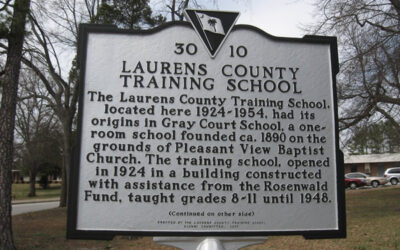
Laurens County Training School
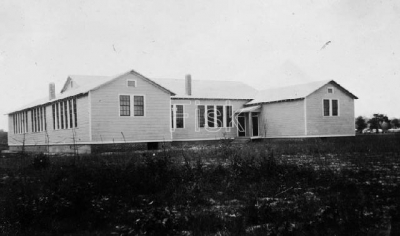
The Laurens County Training School, located here 1924-1954 had its origins in Gray Court School, a one-room school founded c. 1890 on the grounds of Pleasant View Baptist Church. The training school, opened in 1924 in a building constructed with assistance from the...
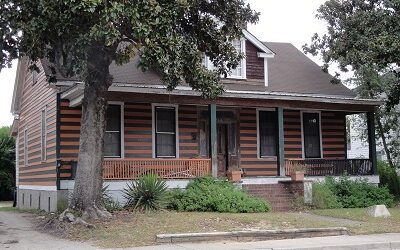
Heidt-Russell House
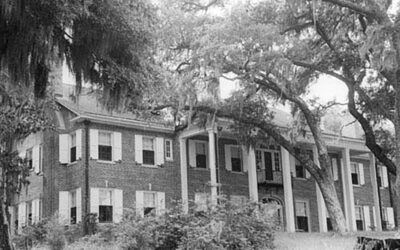
This house was built about 1879 by William J. Heidt, builder and contractor who managed Heidlinger’s Steam Bakery. The Heidts lived here until 1912. Mary E. Russell bought the house in 1919. Edwin Roberts Russell (1913-1996) spent his early years here. A research...
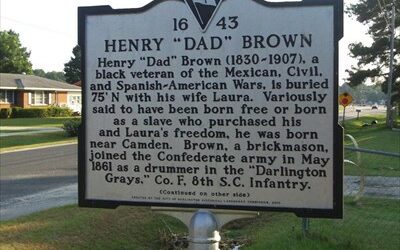
Henry “Dad” Brown
Henry “Dad” Brown, a local blacksmith, landowner, and veteran of the Mexican-American, Civil, and Spanish-American Wars, is buried a few yards from here with his wife, Laura Cannon Brown. Variously said to have been born free or having purchased his and his wife’s...
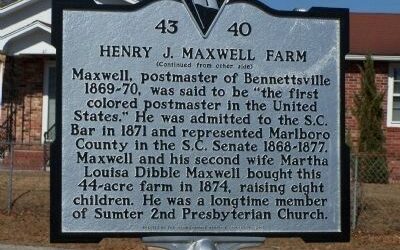
Henry J. Maxwell Farm
Henry Johnson Maxwell (1837-1906), Union soldier, U.S. postmaster, state senator, and lawyer, lived here from 1874 until his death in 1906. Maxwell, the son of Stephen J. and Thurston Johnson Maxwell, was born free on Edisto Island. After serving as a sargeant in the...
Historic Brattonsville
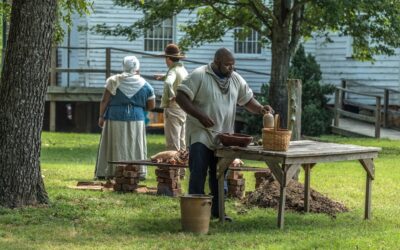
Historic Brattonsville presents the history of the Scots-Irish and African Americans in the South Carolina upcountry largely through preserving and interpreting the story of the Bratton community. This site has more than 30 historic structures from the 1760s to the...
Hobcaw Barony
Created 1905-07 by nationally prominent philanthropist, Bernard M. Baruch, this 16,000-acre property is dedicated to research and education. It includes numerous buildings and sites that reflect the lives of African Americans from the early 19th century through the...
Holly Hill Rosenwald School
The Holly Hill Rosenwald School once stood near this location. Built 1926-27, the Holly Hill School was the third school for African American students built in the area and one of almost 500 funded in part by the Julius Rosenwald Foundation (1917-32). Separate lunch...
Hope Rosenwald School
The two-acre lot for this Rosenwald School was donated by James H. Hope, Mary Hope Hipp, and John J. Hope. James H. Hope, then S.C. Superintendent of Education, was its longest-serving head, 1922-1947. The school closed in 1954. In 1958 it was sold to the Jackson...
Hopewell Rosenwald School
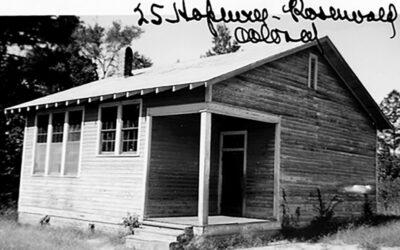
Built in 1926, Hopewell is the only Rosenwald School remaining in McCormick County. Hopewell greatly impacted the education of rural McCormick County’s African American students from 1927 to 1954. By 1954, Hopewell’s enrollment dropped to only nine students as many...
Howard Junior High School
Howard Junior High School (also known as Shiloh School) was built on the site of an earlier school constructed by the Shiloh AME Church. This one-story, wood frame building was constructed in 1924-25 with matching funds from the Julius Rosenwald Fund. The Howard...
Howard School
Georgetown Colored Academy built a school on this site in 1866. By 1908 the building had been torn down and a new school called Howard had been built. By 1950, the elementary (1938) and high school (1938) had moved into a new structure on Kaminski Street. After 1984,...
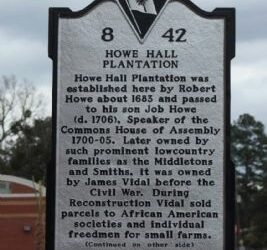
Former Site of Howe Hall Plantation
Robert Howe established an inland rice plantation after moving to S.C. in 1683. Howe Plantation was later owned by several prominent lowcountry families. James Vidal owned the home prior to the Civil War. During Reconstruction Vidal sold parcels to African American...
Huspah Baptist Church and School
Organized c. 1873, the congregation first met in the homes of church members before erecting a permanent sanctuary. It also began operating a school for African American students around 1890. The first school burned in 1895 (arson was suspected, but never proven). It...