Determined to own his own land rather than to rent or sharecrop, former slave Ervin James (1815-1872) bought a 105-acre tract here in 1870. His five sons and a son-in-law later divided the tract into individual farms, and other area families purchased additional land,...
News
The Hundreds
This area was a hub of African American life from the late-19th to mid-20th centuries. On site were the Anderson County Training School, built c. 1922, the Faith Cabin Library, built c. 1935 and a frame store, c. 1900, built nearby by Benjamin Horace Keese...
St. Paul Campground
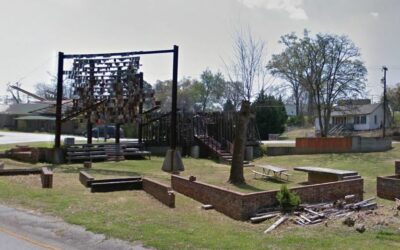
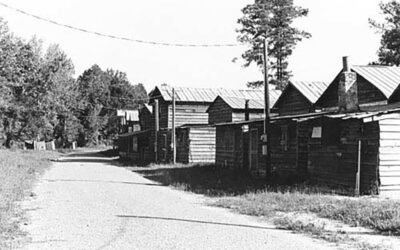
Freedmen in this area held services in a brush arbor at the “Old Prayer Ground” nearby as early as 1869. In 1880 the trustees of St. Paul AME Church purchased 113 acres to establish a campground for annual revivals. They erected an open-sided “tabernacle” and simple...
St. Paul AME Church / Oak Grove AME
One of the first black churches after the Civil War, St. Paul AME began as Oak Grove African Methodist Episcopal Church. Local tradition says that the original small congregation worshipped in the 1850s in the "Bush Arbor," later in the 1880s building a church on...
St. Peter’s AME Church
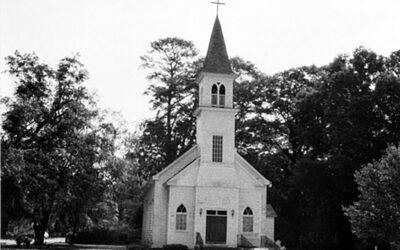
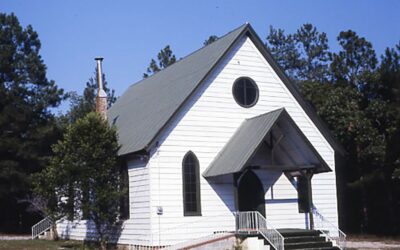
St. Peter’s African Methodist Episcopal Church was formed in 1867 under the leadership of Rev. James Nesbitt. This building, a Gothic Revival wood frame structure, was constructed around 1870. It features Gothic windows and a tower with an open belfry. It is part of...
St. Phillip AME Church
This congregation, organized by 1835, met first in a brush arbor 1.5 mi. N., then constructed a sanctuary on this site shortly thereafter. Its first pastor was Rev. Anderson Burns and its original trustees were Joseph and Robert Collins, Barnes Flowers, Saylor Pope,...
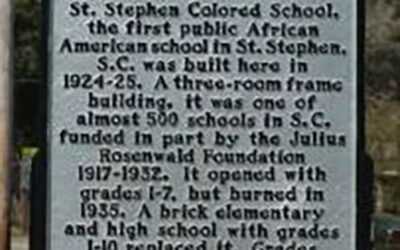
St. Stephen Colored School / St. Stephen High School
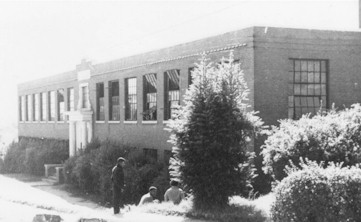
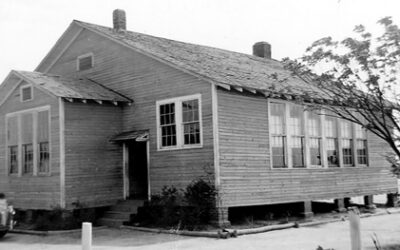
The first public African American school in St. Stephen was built in 1924-25. A three-room frame building, it was one of almost 500 schools in S.C. funded in part by the Julius Rosenwald Foundation. It opened with grades 1-7, but burned in 1935. A brick elementary and...
St. Thomas Protestant Episcopal Church
This church was constructed in 1893. It is a simple wood frame building displaying elements of the Gothic Revival style. In the 1870s Bishop William Bell White Howe established missions for African Americans in the Columbia and Charleston areas. He appointed Rev....
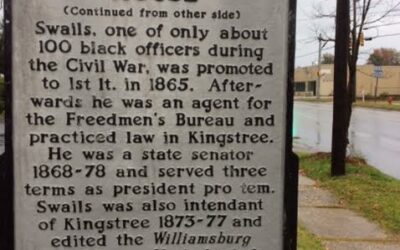
Stephen A. Swails House
Stephen Atkins Swails (1832-1900), U.S. Army officer and state senator, lived in a house on this site 1868-79. Swails, a free black from Pennsylvania, came to S.C. in 1863 as a 1st Sgt. in the 54th Massachusetts Volunteers (Colored), the first black regiment organized...
Sterling High School
Founded in 1896 by Rev. D.M. Minus and called Greenville Academy, this school was first located in West Greenville. In 1902, it moved and was then renamed Sterling Industrial College after Mrs. E.R. Sterling, who had financed Rev. Minus’ education at Claflin...
Stono River Slave Rebellion Site
On September 9-10, 1739, an Angolan slave named Jemmy led a slave rebellion involving some 80 slaves enlisted from area plantations. After attacking a warehouse and seizing weapons, the slaves marched toward St. Augustine, Fla., burning homes and buildings and killing...
“Bench by the Road” at Sullivan’s Island / Fort Moultrie
Beyond military defense, Fort Moultrie tells the story of Sullivan's Island’s role as an entry point and quarantine station for West Africans who were brought to the Carolina colony during the Middle Passage. Historians estimate that slave ships brought 200,000 to...
St. Anne’s Parochial School
This historic marker narrates the story of, the first Catholic church in York County as well as the first school in S.C. to integrate. Founded in 1919 by the Rev. William A. Tobin of Columbia, St. Anne’s was originally built on Saluda Street in 1920 but closed in...
St. James AME Church
The congregation of St. James AME Church first worshipped under a brush arbor in the vicinity of what is now Ariel Crossroads. Mattie Munnerlyn White sold one-half acre of land, including the original church, to church trustees in 1891. The cornerstone of the current...